
Gen4P: Video Generators are 4D Perceivers
Method
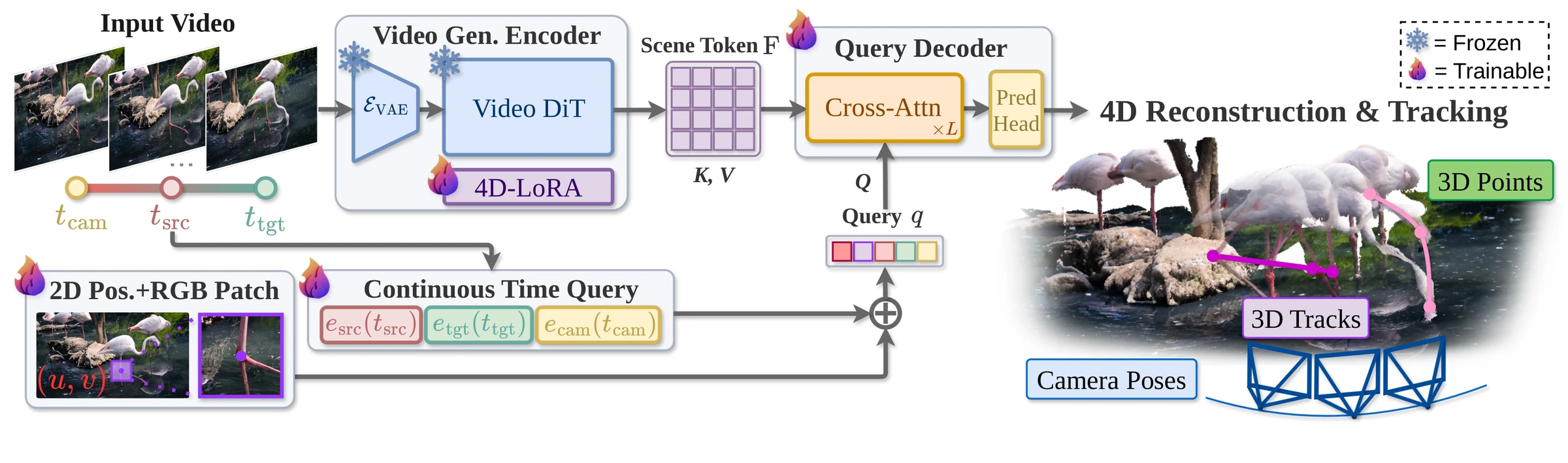
TL;DR: Gen4P repurposes a video generator for feed-forward 4D perception, with single-pass encoding, on-demand decoding for spatial flexibility, continuous-time embeddings for temporal flexibility, and a frozen depth LoRA as a plug-in geometry prior.
Qualitative Results of 3D Tracking
Additional Qualitative Results
Confidence-based filtering are applied for the best visual quality.
We tune with our best efforts to maintain the visual quality on all methods.
Acknowledgment
This research is supported by the NTU SUG-NAP and National Research Foundation, Singapore, under its NRF Fellowship Award NRF-NRFF17-2025-0009. We would like to acknowledge the High Performance Computing Centre of NTU Singapore, for providing the computing resources, facilities, and services that have contributed significantly to this work. Zeren Jiang is supported by Clarendon Scholarship.
BibTeX
@misc{xia2026gen4p,
  title={Gen4P: Video Generators are 4D Perceivers},
  author={Yitong Xia and Zeren Jiang and Chuanxia Zheng},
  year={2026},
  eprint={2610.XXXXX},
  archivePrefix={arXiv},
  primaryClass={cs.CV},
  url={https://arxiv.org/abs/2610.XXXXX}
}